

Winter strips a wood back to its bones, and that is exactly why it is a good time to go looking. With the leaves gone, the distraction goes with them: what is left is bark, buds, twigs and the shape a tree makes against a low grey sky. Those clues never disappear, so the skill you build between November and March will serve you in every other month too. It also means you can name a tree in a hedgerow or a park when there is almost nothing obvious to go on.
Start with the silhouette
Stand back before you go close. At twenty metres a bare tree is a drawing, and the outline is often enough to get you to the right family. Oak is broad and heavy, its crown usually wider than it is tall, with thick limbs that kink and twist as they branch. Ash looks lighter, with branches that sweep upwards into a rounded dome. Silver birch is airy and fine, a purple-brown haze of drooping twigs. Beech holds a dense, tight mass of fine twigs almost to the top.
Silhouettes read best against a low winter sun or a foggy morning, when the small twigs show as detail rather than a smudge. Learn five outlines and you will start recognising trees from a train window.
Bark is useful, but it lies
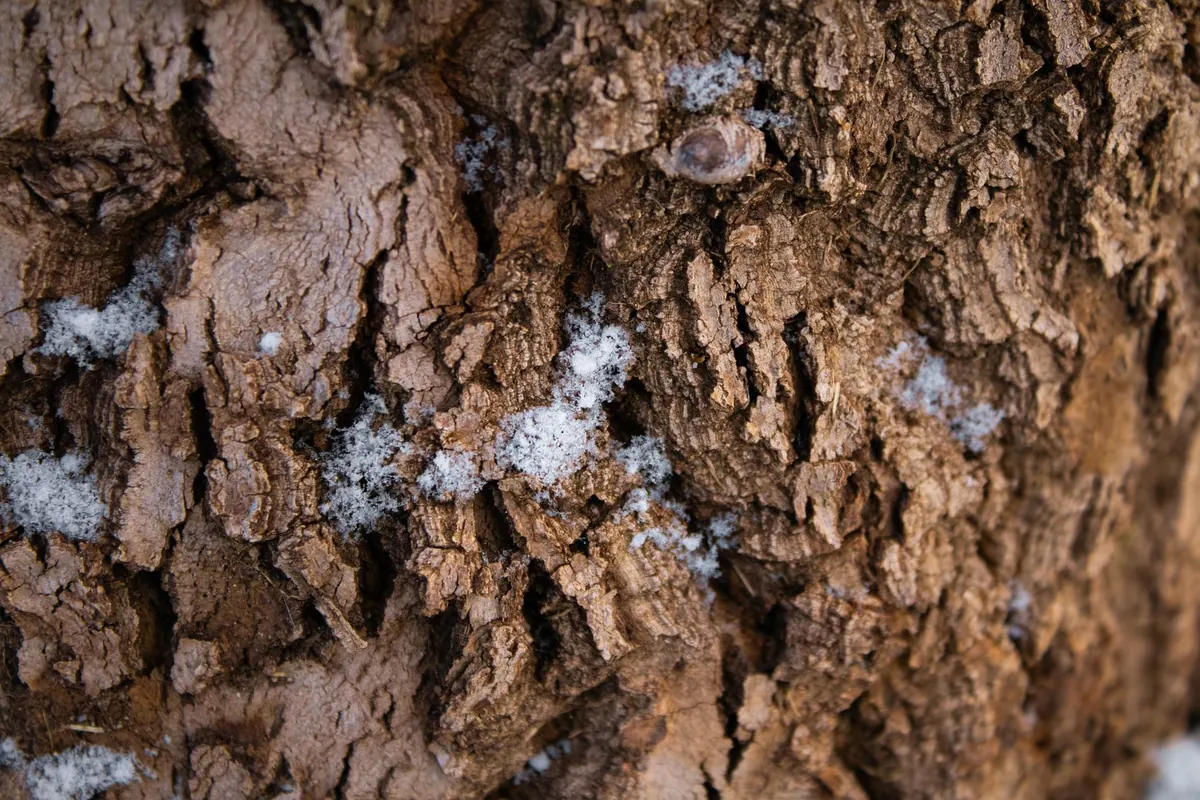
Bark is the first thing beginners reach for and the last thing they should trust. It changes with age, weather and situation. A young oak is smooth and grey-brown; a mature one is deeply fissured into vertical ridges, sometimes with burrs and knots. Beech stays smooth and grey, like elephant skin, with faint horizontal lines — though old beeches can turn ridged, mossy and difficult. Ash is grey and smooth when young, then develops diamond-shaped ridges. Silver birch is unmistakable: white, papery, peeling in horizontal strips, with dark diamond-shaped scars.
Then the weather interferes. Wet bark is far darker than dry bark, and moss, algae and lichen cover everything given half a chance. Alder growing by water often looks green with algae; the same species on dry ground looks dark and cracked. Use bark to narrow your options, not to settle the question.
Buds and twigs settle the argument
Opposite or alternate?
If you want one reliable clue, it is the arrangement of the buds along the twig. Almost every UK tree does one of two things.
- Opposite buds — pairs sitting level with each other on either side of the twig. Ash, sycamore, field maple and horse chestnut do this. It is a short list, which makes it useful.
- Alternate buds — single buds spiralling up the twig, never in pairs. Oak, beech, birch, hazel, hawthorn, willow, lime and wild cherry all fall here.
Reading the bud itself
Once you know the arrangement, the buds give the rest away. Ash buds are soot-black, chunky and velvety — nothing else looks quite like them, and they sit on grey twigs beside a pale, notched leaf scar shaped like a horseshoe. Oak carries clusters of rounded brown buds bunched at the tip of the twig rather than spaced along it. Beech buds are long, slender and sharply pointed, held out from the twig at an angle; from a distance they look like small brown pencils. Hazel twigs zigzag slightly, are softly hairy and carry oval green-brown buds, and by January the catkins hang like lambs' tails. Sycamore buds are big and green; horse chestnut buds are large, sticky and shiny. Willow is different again, its buds lying almost flat against the twig with a single cap-like scale.
Two more details are worth learning. Thorny twigs mean hawthorn, blackthorn or crab apple, and in winter blackthorn often still carries small black sloes or their wrinkled remains. And a twig that snaps with a sharp crack, leaving a neat white break, is usually birch.
A field method that works
Try this order every time. It takes two minutes and stops you guessing.
- Look at the whole tree from a distance. Note the shape, the height, and where it is growing — wet ground, hedge, woodland edge.
- Take a twig you can reach and check the buds. Opposite or alternate?
- Study the buds closely: colour, size, shape, whether they sit tight or stand out. A x10 hand lens helps.
- Look at the bark and any dead leaves still clinging. Young beech, young oak and hedgerow hornbeam often hold rust-brown leaves all winter.
- Check the ground underneath. Acorns, beech mast, ash keys, hazel shells, alder cones — the litter tells the truth even when the tree puzzles you.
- Confirm with two features before you commit. One match is a guess; two is an identification.
Winter's traps for beginners
Beech and hornbeam trip people up, because both have smooth grey bark and slim buds. Hornbeam buds are shorter and sit closer to the twig, its twigs zigzag more strongly, and its bark has fluted, sinewy ridges running up the trunk. Ivy is another obstacle: a trunk wrapped in ivy hides the bark entirely, so look higher up the tree.
Scent is often suggested as a tool — scratch a young wild cherry twig and you may catch a faint marzipan note — but cold weather mutes it. Treat scent as a nudge rather than proof, and never strip bark to test it. Young trees and coppiced regrowth also look different from mature trees of the same species, so compare like with like.
What to carry
- A x10 hand lens, for bud scales, hairs and leaf scars.
- A pocket tree guide, or a tree key saved offline on your phone — signal in woods is unreliable.
- A notebook or camera, so you can compare this month's twig with last month's.
- Gloves and boots you don't mind getting muddy.
Work only from twigs you find lying on the ground. Pulling live buds off trees damages them, and on many reserves it is not permitted.
Make it a winter habit
Pick one wood or park near you and walk it once a month from November to March. Choose five trees — oak, ash, beech, hawthorn and silver birch is a good starting set — and return to the same individuals each time. Watch how the buds swell, how the ash keys drop, how hazel catkins lengthen and willow turns from grey to gold. By March you will know those five without hesitating, and the next five will come far more quickly.
Winter is also the quiet season for noticing everything else: rotted stumps, old nests, deer and fox tracks in mud, the first green shoots. Go slowly. Look up, then down, then at the twig in your hand.
Photo: Tuğba / Pexels